


When I monitor patients early in an egg retrieval cycle, I am frequently asked some version of “I’ve been on injections for multiple nights now. Why do I not feel anything? Are my ovaries working?” Multiple IVF retrievals later I understand the temptation to want to decipher every “twinge” (or lack of one).
IVF stims usually last 8 to 12 days, starting on day 2 or 3 of your period (or post birth control). The most common IVF side effects are bloating, a full or heavy pelvis, fatigue, headaches and injection-site soreness. These tend to be more prevalent in the second half of stims as your ovaries grow and then tend to resolve with your period. This usually occurs 1-2 weeks after egg retrieval. These are NORMAL effects of ovarian stimulation. Not “red flags.”
I’m Dr. Lucky Sekhon, a double board-certified REI and infertility specialist in New York City, and an IVF patient myself. I’m also the author of The Lucky Egg. I spend a lot of time in clinic, on Instagram, and in my The Lucky Egg Drop newsletter debunking fertility myths. Here’s a breakdown of how you may feel day by day of stims, what is normal, what you should avoid, and the select few symptoms that are a “call your clinic.”
IVF stims last 8 to 12 days for most people
Stims is short for ovarian stimulation, which is your daily injections of hormones that stimulate multiple follicles to grow (your body only matures one follicle in a typical month). The specifics of which medications and why are in my guide to IVF medications and protocols. But let me talk about how these days go and their place in the IVF process.
In my practice, patients stimulate for 8-12 days. We begin with a baseline ultrasound and bloodwork and then see you back for repeat measures. Typically, the estrogen levels will increase before I see follicle growth on ultrasound. So at your first couple monitoring visits, I’m ok with not seeing any growth. This is what my cycles look like in my clinic-not guaranteeing yours.
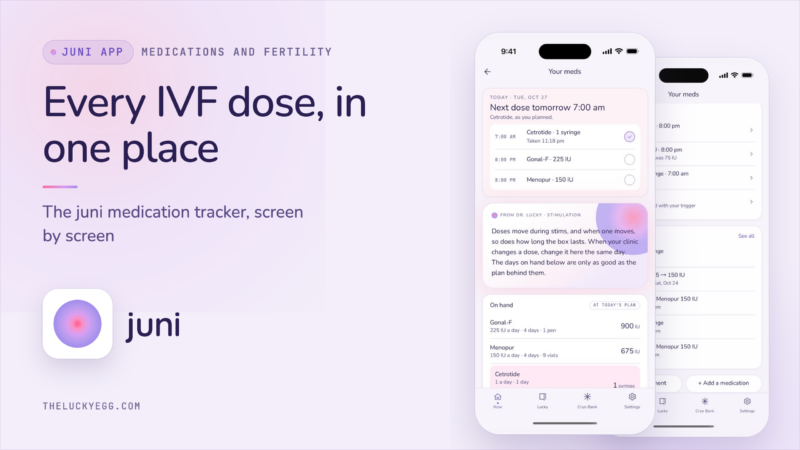
You can’t get your final doses and your retrieval date at your baseline visit. Your “day six” is not going to be the same as someone’s on TikTok. Because your team is changing what you are doing based on your response on your scans. When a dose changes after a scan, you can update it in juni and log the monitoring visit next to it.
IVF stims day by day, from the first injection to the trigger shot
This is based on my clinic’s cycle and not a standard schedule. “Day 1” is the first day of injections not the day 1 of period.
| Phase | What is happening | What the clinic checks | What you may feel |
|---|---|---|---|
| Days 1–4 | Follicles start under 10 mm. Estrogen rises before growth is visible. | Baseline ultrasound and bloodwork, then a check after a few days of injections. | Often very little beyond injection-site tenderness. |
| Days 5–8 | Growth shows on ultrasound. Past 10 mm, follicles grow about 1–2 mm a day. | Ultrasound and hormone levels, with visits getting closer together. | Bloating, pelvic fullness and fatigue can begin. |
| Days 9–12 | The late burst of growth. Follicles vary in size and the lead ones approach 18 mm. | Near-daily monitoring; the clinic decides when to trigger. | Bloating and pelvic heaviness are at their peak. |
| Trigger night and after | The trigger shot starts final egg maturation, timed 36 hours before retrieval. | The exact trigger time and your retrieval instructions. | Ovaries stay enlarged; activity restrictions continue after retrieval. |
The level of evidence for this is “me in my clinical practice, but not a validated symptom schedule day by day”. See my IVF medications guide for sample day by day schedule of which med goes when. See my follicle-size guide for what the numbers mean.
Days 1–4
You learn how to inject, perhaps your skin feels sore, and otherwise you feel pretty normal. Just because you feel normal, however, doesn’t mean the medicine isn’t working. In the first 4 days the bloodwork and the ultrasound are telling me far more than how well your jeans fit.
Days 5–8
Now I can start to see individual follicles growing. They don’t all get started at the same time. There’s a first group that grows first, and then a second group. We say that a follicle is mature at around 18mm, but if you get a follicle that’s 14mm or bigger on the day of the trigger you have a pretty good chance of getting a mature egg. This is because follicles continue to grow in the 2 days between trigger and retrieval.
Typically we start putting restrictions on your activity at this point when your ovaries start to grow as seen on your scan.
Days 9–12
The end part can feel like someone has put 2 balloons up in your pelvis and have gently blown them up. Walking fast is an issue, your low belly feels tight and waistbands are evil. You’re checking in all the time, every day. More bloating does not necessarily mean more eggs or better embryos and very little bloating does not mean a bust.
Trigger night and the 36 hours after
The trigger (hCG, Lupron, or both if your protocol calls for that) is the one that finishes off the maturation of your eggs. Retrieval will then be 34 to 36 hours later, prior to the time when they would otherwise be released.
This is the injection for which “time of day” is most important out of all your injections. I advise patients to put everything together, medication out, ready to go, 10-15 minutes early, with an alarm as a back up. juni keeps your trigger medication and the countdown to retrieval on your phone. If you do mess up time-wise, definitely call the clinic immediately rather than make it up, they may reschedule your time of retrieval. In addition, your ovaries don’t just shrink at the moment they take your eggs out, hence the restrictions below are applicable to egg retrieval recovery as well.
The IVF side effects that are normal during stims
Evidence tier: established. FDA medication labels list abdominal pain and swelling, headache, and injection-site reactions; ASRM’s patient guidance adds breast tenderness and mood swings.
Some will have little to no symptoms throughout the 8-12 days. Others are drained by day 9. Neither is an indication of retrieval success.
Bloating and a full pelvis
This is the headline act. High estrogen leads to water retention. A bunch of growing follicles on the ovaries means more space taken up. You’ll feel a low pressure feeling in your pelvis not the upper ab bloated feeling like when you eat too much. In patients with low egg reserve it can be low to absent. In patients with lots of eggs and a good response it can be more significant.
I had the end of stims bloat during retrievals. During a straightforward cycle, it gets better post retrieval and will resolve when you get your period (1-2 weeks later). Rapid or severe swelling is a call in thing though. Read ASRM’s OHSS guidance.
Fatigue
Second most frequent problem I hear is fatigue due to hormonal changes, 7 a.m. monitoring visits, extra treatment load, etc. Try to limit due dates and outside obligations to the bare minimum for the 2 weeks of stims, if possible.
Headaches
Some people get hormonal headaches. Those are worse with dehydration. Headache is among the most common reactions on the Gonal-f label. So drink water, and see what your clinic suggests for pain relief. (I usually advise my patients that Tylenol and caffeine are acceptable means of treating headache during stims.) And call if you have a sudden/severe/odd headache.
Mood
This is the number 1 side effect people are afraid of, but I see less of it than bloating (at least in my experience). Some people are a little more sensitive, or stress themselves out more. Some people feel… really great. I call it the “estrogen high” – not like PMS, which is when progesterone drops after ovulation. Evidence level: that’s my experience in clinic. No, how grumpy you are about another early blood draw won’t change how your ovaries are going to react.
Injection-site soreness and bruising
Minor redness, stinging, itching and/or bruising are recognized local reactions that usually aren’t severe and are of short duration. Have your nurse check your technique if you are having difficulty with the injections. If you have redness or warmth that is spreading or severe swelling call that day. Difficulty breathing or swelling of the face or throat is an emergency.
IVF medication side effects: how common each one is in the trials
For three of the most commonly prescribed stims drugs, the FDA labeling will tell you what % of the time each side effect occurred in their trials for IVF. I have categorized it based on the symptom because that is what you experience.
| Side effect | How often it was reported in IVF trials | Source |
|---|---|---|
| Abdominal pain | 6.7% with Menopur (434 patients); listed at 5% or more with Gonal-f RFF | Menopur label, Gonal-f RFF label |
| Headache | 6.2% with Menopur; 1.1% with Cetrotide (949 patients); listed at 5% or more with Gonal-f RFF | Menopur, Gonal-f RFF and Cetrotide labels |
| Enlarged abdomen | 2.3% with Menopur; listed at 5% or more with Gonal-f RFF | Menopur and Gonal-f RFF labels |
| Abdominal cramps | 3.0% with Menopur | Menopur label |
| Nausea | 1.3% with Cetrotide; listed at 5% or more with Gonal-f RFF | Cetrotide and Gonal-f RFF labels |
| Injection-site reactions | Pain or reaction 3.9% and inflammation 2.3% with Menopur; bruising listed at 5% or more with Gonal-f RFF | Menopur and Gonal-f RFF labels |
| OHSS | 6.2% in the Menopur trials; moderate or severe OHSS in 3.5% in the Cetrotide studies | Menopur and Cetrotide labels |
These numbers are from various trials, with various people, various older protocols. They are not in direct competition with one another. Plus in a trial, it is whatever was reported as an adverse event. That is why “enlarged abdomen” looks far rarer on paper than the bloating I see in my monitoring room.
No similar trial number for the trigger shot. See my Lupron explainer for a breakdown on the trigger shot differences.
Restrictions during IVF stims: exercise, sex and sleep
This is my clinical opinion and the advice I give my patients. It’s not a randomized trial proven time table but a caution based on anatomy. An ovary is supposed to be free floating, about 2cm x 3cm in size. By the end of stims it could be 7-8cm and that size can cause the ovary to twist on itself and get stuck. Which will cut off the blood supply to the ovary. That is ovarian torsion, and it is a surgical emergency.
Exercise: once you start seeing growth usually around 3-5 days in to injections, I tell patients to stop running, jumping, elliptical, intense cycling, Pilates, yoga inversions and anything core centric. Ok to do is walking, light stretching and arms. The restriction lasts at least 1-2 weeks after retrieval. Good rule of thumb is ok to start back when you have your period (you’ll know ovaries are back to normal sized). Ovarian torsion is uncommon – 0.13% in hCG trigger with fresh transfer and 0.018% for Lupron-trigger freeze-all cycles in a retrospective study of 15,577 cycles. Which gives you some suggestive data as to type of trigger but does not test for exercise. I have a more detailed post on what to know about exercising during and after an egg retrieval cycle. None of these limits apply before stims start: I cover exercise while trying to conceive separately, and the rules change again for exercise during an embryo transfer cycle.
Sex: I tell patients to not have sex from the time their ovaries start to get bigger to 1-2 weeks after retrieval. Again, because it’s high impact on your ovaries.
Sleep: no required position during stims. Put a pillow under or between knees. Find what’s comfortable to take the pressure off your belly. You should not have the type of pain that keeps you up during stims. Call your clinic for that.
The symptoms during stims that mean you should call your clinic
Much of it is just pelvic fullness. Don’t try to power through rapidly worsening symptoms. OHSS is a case of too much of a response, where your blood vessels become leaky and the fluids end up in your abdomen. ASRM describes mild bloating/nausea as one end (about 1 in 3 patients experience some of this during stimulation) and vomiting, dehydration, shortness of breath and blood clots on the other end.
Call your clinic the same day for:
- Abdominal swelling or weight that increases quickly
- Pelvic pain that keeps getting worse
- Nausea or vomiting that does not let up, or not being able to keep fluids down
- Urinating much less than usual
Go to the emergency room for:
- Sudden, severe pelvic pain, especially on one side and especially if it comes and goes (the pattern of torsion)
- Shortness of breath or chest pain
- Fainting
- Pain and swelling in one leg
ASRM puts severe OHSS at about 1% of cycles. National CDC surveillance data has shown a decrease in the incidence of OHSS in the country, from 14.3 per 1,000 IVF cycles in 2006, to 5.3 per 1,000 in 2015. ASRM prevention guideline lists a Lupron (GnRH agonist) trigger as the first line of prevention, and a freeze-only cycle for high responders. It names PCOS, a high AMH and a high expected number of eggs as the risk factors. If you have PCOS, high antral follicle count, or prior OHSS event, make sure to ask about their prevention strategy prior to trigger.
Keeping the days straight during stims
So if you’re 4 injections in and waiting for any signs something’s going on? Remember those first 4 days are generally pretty low on feeling anything. And the 9-12 day bloat is not an assessment of your eggs. It’s ultrasound and bloodwork that will drive decision making, not the size of your waistband.
Schedule is one thing you can control. juni gives you a central location for stims and trigger medications, your monitoring logs and cycle countdown – check out my guide to my IVF medication tracker. Always defer to your clinic’s written instructions.