

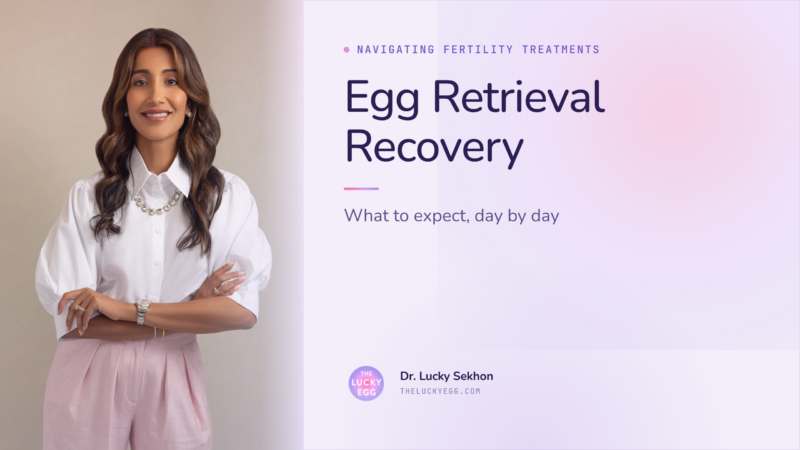
You did it. After two weeks of shots and early morning appointments to check on your follicles, all growing up like that reality TV show but with some serious stakes, you’ve had your eggs retrieved. And then the first question is nearly always: “Ok, when will I feel normal again?”
Here’s the short answer: egg retrieval recovery is usually quick. You may be groggy and crampy on the day of your retrieval, puffy or sore for 2–5 days, and much better once your period arrives around 1–2 weeks later. You may get some light spotting. Or some fatigue and constipation. But if you have severe pain or pain that’s getting worse. Rapid weight gain. Shortness of breath. Persistent vomiting. Fainting. Fever. Heavy bleeding. You don’t want to power through that. Call your clinic ASAP.
Hi. I’m Dr. Lucky Sekhon. Double board certified Reproductive Endocrinologist and Infertility (aka REI) doc here in New York City. Author of The Lucky Egg: Understanding Your Fertility and How to Get Pregnant Now. And multiple egg retrieval survivor. You can also take a look at juni, a comprehensive IVF companion app that I am building (it’s in beta, and you can join early access). I spend a lot of my time between taking care of patients, providing fertility education on Instagram, and writing my newsletter The Lucky Egg Drop, distilling what’s important from the noise. I want to help you understand what’s going on in your body. What you can do to feel better. And most importantly – when should you be calling your doctor about a symptom.
Recovery after egg retrieval usually takes a few days, and your period is the finish line
I always tell my patients that the egg retrieval is really the easy part of IVF in terms of time you have to spend in the procedure room. Ultrasound guided vaginal needle through the vaginal wall that we aspirate from each of the ovarian follicles to get fluid. That all takes 10-15 mins or so. We sedate you and you go to recovery and then leave that day. The eggs are now out of the building but your ovaries have no idea the party is over yet…
I was so surprised that I felt so much better so fast with the retrievals I had a few years ago. It’s always stuck with me and it’s a win to me in a retrieval not only to have a good number of mature eggs come out but that the recovery for a patient doesn’t really uproot their lives. Reasonable bloating and some discomfort from cramps and able to get back to their lives (aside from any major complications of course). Most of my patients are going back to work/school the next day. Not everyone should be expecting to be back to full capacity though.
Evidence that severe pain is rare: in a prospective study of 1,058 egg retrievals, 3% of patients had severe or very severe pain immediately afterwards, 2% had severe pain 2 days after, 0.7% were hospitalized for pain. So while those numbers aren’t something to ignore if someone is hurting, if you’re having significant pain then you should be called back to have that evaluated and assessed and not just told to suck it up.
Evidence: My 1–2 week recovery timeline is clinical experience; the published prospective study supports that severe postoperative pain is uncommon.
Egg retrieval recovery day by day: what you will probably feel, and why
Patients are suckers for a timeline. So am I. IVF is just one continuous waiting game until the next phone call. Knowing a bit about what to expect may help with the recovery aspect of things. Think of the timeline below as a weather report, not a commitment. You can use it for planning, but individual symptoms will vary based on how robust your ovaries were, how many eggs were retrieved, and if you’re doing a fresh transfer.
After egg retrieval, day by day
| Day | What’s happening | What you may feel | What to do |
|---|---|---|---|
| Day 0: retrieval | Sedation wears off; follicles drained but ovaries enlarged | Grogginess, cramps, fullness, light spotting | Rest; arrange a driver; follow clinic’s pain-medication advice |
| Days 1–2 | Ovaries still enlarged; hormones shifting | Bloating, constipation, fatigue, bathroom twinges | Many return to work; allow longer if >20 eggs; report severe pain |
| Days 3–7 | Ovaries gradually settle; potential early-OHSS window | Bloating may peak before easing | Stay alert for worsening symptoms; avoid high-impact activity and sex |
| Days 7–14 | Hormones fall; period commonly arrives | Bleeding, cramps, temporary mood changes | Symptoms usually improve; check with clinic before resuming exercise |
| After 2–3 weeks | Most return to baseline; fresh-transfer patients may need continued monitoring | Occasional residual bloating | Discuss persistent or worsening symptoms with clinic |
Typical ranges, not a guarantee. Escalating or severe symptoms require assessment.
On the day of retrieval: take the day off. Even if you feel almost back to normal by nightfall, sedation makes you tired and can affect judgement. Arrange for someone else to get you home. A little bit of spotting/cramping isn’t necessarily indicative of a problem. You can consider taking Tylenol/Motrin, if your clinic okays it, but ask specifically about ibuprofen for a fresh transfer – some clinics suggest avoiding this.
First few days: I just want patients to be comfortable and generally heading in the right direction. Not necessarily ideal, but comfortable. If you had over 20 eggs retrieved you can probably add an extra day or 2. The ovaries have been working harder, and the bloating might be a little worse. Twinges when you go to pee or poop might surprise you. But they make sense anatomically – the bladder and rectum are right next to the ovaries. Read more about where retrieval falls in the IVF timeline and when you can exercise again.
Bloating after egg retrieval comes from enlarged ovaries and high estrogen, and it peaks before it fades
Probably one of the biggest complaints after retrieval is the bloating. Sometimes patients will tell me that they look pregnant. This can be especially upsetting emotionally if they are doing IVF to get pregnant. I remember that it took me 2-3 weeks for the IVF bloating to completely go away. It did go away. So I want to explain to you that the temporary change in your body does not mean you will gain weight permanently.
When we stimulate multiple follicles (rather than just the 1 dominant follicle that usually develops in your unmedicated cycle), then your ovaries can get quite large. Usually the size of your ovary is about 2 x 3 cm. But, a really well-stimulated ovary can become 7-8 cm. So think about two organs that are much larger than they usually are in a pelvis that wasn’t really meant to be luxury real estate in the first place.
In addition to that, the high estrogen levels can cause fluid retention. And the stimulated ovaries secrete stuff that makes the blood vessels leaky and so a little bit of fluid can be pushed into the tissue around the ovaries. The more “robust” your ovarian response, the more you might feel that bloated, tight feeling. (See the ASRM guideline on ovarian hyperstimulation syndrome for a description of this.) This is established physiology. It is not that your body is doing something wrong because your jeans don’t button.
Those with lower egg number may not get much bloating at all. While those with high response, especially those who have PCOS or high ovarian reserve may have more. The same ASRM guideline talks about the risk factors for OHSS. Like an antral follicle count over 24, AMH over 3.4 ng/mL, or more than 15 oocytes retrieved. Just because you have these risk factors for OHSS doesn’t mean you will get OHSS. But it’s part of the reason why your clinic is concerned with your symptoms. If you’re wondering how your follicles grew during stimulation, that process explains what your ovaries are recovering from.
Constipation, trapped gas and bathroom twinges after egg retrieval are common and usually short-lived
Can I ask you a mundane question? A trip to the bathroom after a retrieval may feel like a big deal. The ovaries are swollen. They’re right next to the bladder and rectum. Sometimes you feel a little twinge when you urinate or go to the bathroom. It doesn’t necessarily mean you’re injured. However, discomfort should be mild and be getting better, not severe.
You may have constipation and/or gas building up and making pressure worse. I’ve noticed that this is a mix of a) sedation b) being less mobile temporarily c) changing what you’re eating and drinking around the time of procedure d) swollen ovaries taking up more space. Progesterone can also slow down your bowels. Especially if you’ve started progesterone for a fresh transfer. Just my clinical opinion, not based on a study – no one has done a trial looking into constipation after a retrieval.
Drab suggestions for you: Drink fluids. Eat things with fiber in them. Take gentle walks if you feel comfortable. Ask your clinic if they think a stool softener is a good idea. Eat things that sound good to you. Feel free to eat protein filled meals if you’re wanting that. No special post retrieval eating plan required. No evidence that pineapple, or fancy electrolyte powder or any specific meal is going to affect how many eggs you had or the quality of eggs retrieved. The post retrieval recovery foods are about making you feel better, not about changing the report of the embryologist.
Your period after egg retrieval usually comes within 1–2 weeks, and it can be heavier than usual
One of the most common questions I get is, “When do I get my period after egg retrieval?” In a non-pregnancy or non-continued hormone supported cycle, I would typically suggest people expect a withdrawal bleed or period in the 1-2 weeks range. After all the hormone craziness, your estrogen and progesterone levels are going down. Uterus stops getting support from the hormones and just sheds. The ovaries will gradually shrink back down to pre-stim size.
The first period after egg retrieval may be heavier or more crampy than usual. It could also be a bit of an emotional rollercoaster as well. Sometimes, people refer to this as “hormone crash”, meaning feeling more tired, emotional or irritable that may coincide with this big decrease in hormones from stimulation. (not actually a diagnosis or proof that hormones really are behind every mood swing! It’s just a good way for folks to describe what they’re feeling. If you’re feeling unusually down or upset, definitely let your team know.) No need to play down the emotional side of things as well.
For many people, the period is a sign of the end of the physical recovery from it all. But also a new beginning! For many people, I’m not automatically recommending adding a cycle onto their schedule before another retrieval or frozen embryo transfer (as long as they’re recovered, and looking good on evaluation!). I do recommend slowing down if there was severe OHSS, other complications, or just not enough emotional energy to go at it all again. If you’re looking forward to transfer, here is my guide to starting FET prep with your next period.
What to avoid after egg retrieval: high-impact exercise and sex until your period, because of ovarian torsion
It is usually my recommendation that people continue with normal life through the process of fertility treatments. However, this is one “no, no” that I will really hold firm to. If you have enlarged ovaries you should not be engaging in things that will potentially bump or twist your ovaries. This means NO running, jumping, intense core work. Also NO penetrative sex until your period and your clinic gives you the go ahead that it is safe.
The problem is ovarian torsion. When your ovary is enlarged it can twist on its supporting ligaments and this may disrupt the blood flow to the ovary. It is like a “heart attack for ovaries” if there is prolonged interruption of the blood supply it can harm the ovary. While torsion is very uncommon it is a surgical emergency should it happen. Sudden severe and often one sided pain in waves should NOT be confused with the normal cramps of retrieval.
OHSS after egg retrieval is rare now, and these are the signs to call about
OHSS = Ovarian hyperstimulation syndrome. It’s a scary sounding term and it CAN be serious. However, one of the most exciting parts about modern IVF is that we have some amazing ways to prevent it now. OHSS is when your stimulated ovaries secrete substances that make your blood vessels abnormally “leaky”. As a result, fluid can move out of the blood vessels and collect in the abdomen. This can lead to progressively more distension and nausea/vomiting and in severe cases it can affect your ability to breathe/circulate blood/kidneys, etc.
According to the ASRM guideline for 2024, in the past moderate/severe OHSS has occurred in 1-5% of IVF cycles. This is a range historically with all the different IVF protocols, not specific to what will happen in your cycle this time. One huge change that has happened is the switch in some patients to using a GnRH agonist (aka Lupron trigger) instead of a full dose hCG trigger. This is a game changer. Lupron is the MVP. Deciding to freeze all your embryos and not do an immediate fresh transfer (if you are a candidate) and prescribing cabergoline in some high responders, are both ASRM recommendations which also can help to lower the risk. Check out my IVF medications and protocols article for more info about the big picture.
Part of what helps us catch it is that there are some general timelines. Early OHSS usually starts 4-7 days after the trigger shot. This often resolves with the onset of your period. Late OHSS usually starts 9+ days after the trigger shot. This can be related to hCG from early pregnancy (if fresh transfer) and can sometimes be more severe. See the ASRM guideline for more on this. So even if your day of retrieval felt great, if things progress and get worse over the following few days, make sure to report this.
These symptoms after egg retrieval mean a same-day call to your clinic
Call promptly for:
- Severe or worsening abdominal pain
- A belly that is swelling quickly
- Weight gain of more than about 2 pounds (1 kg) in a day
- Nausea or vomiting that keeps you from holding fluids down
- Much less urine than usual
- Dizziness when standing
- Calf swelling or pain
- Fever
- Bleeding that soaks a pad in an hour
Shortness of breath, chest pain, passing out, or sudden intense one-sided pain (that wave-like one-sided pain is particularly worrisome for torsion) need evaluation right away, not a message left for the next business day. These are the warning signs of significant OHSS and post-procedure complications described in ASRM guidance.
I would always rather hear from someone who turns out to be fine than have a patient sitting at home wondering whether they’re “overreacting.” You can ask for help.
Bleeding, infection and injury after egg retrieval are uncommon, and this is what they look like
Egg retrievals are a minimally invasive procedure, but it’s a needle going through the vaginal wall into the ovarian follicles. It’s normal to have a little spotting from the puncture points. But you wouldn’t be expecting heavy bleeding or a fever or increased pain. The bladder, bowel and rectum are nearby where we’re working. So while it’s rare to injure them, it’s one of the complications that we pay attention to in the fertility world.
A 2018 review of 23,827 egg retrievals showed that there were complications in 0.4% of retrievals, at least 24 hours hospitalization in 0.29% and surgery in 0.1%. A previous prospective series of 1,058 retrievals, they recorded 2.8% having vaginal bleeding. No intra-abdominal bleeding or pelvic infection in that particular group. Rare isn’t never. And the average in a study doesn’t give us any information about what’s happening in you.
This is important. So expect some mild spotting that resolves. But don’t expect soaking a pad in an hour. Expect cramps that improve over the next few days. But if pain increases after day 3, give us a call. Fever over 100.4F (38C), foul smelling discharge, worsening tenderness of the pelvis might mean an infection. If your gut is saying your recovery is going from uncomfortable to concerning, give your clinic a call to tell us what is different.
The Bottom Line
Sooo you’ve spent the last couple of days looking down at your belly, dissecting all your cramps, and Googling if it’s normal to have felt a weird pang in the bathroom?
Right there with you. IVF is all about hyper-awareness when it comes to your body…and it’s hard to turn it off the moment you wake up from your retrieval. (I’ve been both the fertility doctor talking about these symptoms and the patient experiencing these symptoms.)
Long story short – post egg retrieval recovery is usually short and should improve over time. Bloating, minor cramping, constipation, a short-term hormone induced mood low? Sure. But anything that’s intense pain, rapidly increasing bloating, heavy bleeding, fever, fainting, respiratory distress? No.
Learn the difference and keep in touch with your clinic.
And please don’t make post-retrieval recovery another fertility performance test where you need to get the perfect diet, or add more days of rest or ‘the right’ supplement to rewrite the biology of the eggs that you just retrieved. Meanwhile, in the lab they may be working hard on grading your embryos…or if you’ve frozen your eggs you can use my egg-freezing success calculator to put your count in context. For more evidence based info without the fear mongering, follow me at @lucky.sekhon and/or subscribe to The Lucky Egg Drop and/or read The Lucky Egg. You deserve to have clear info (and a little room to breathe) while your body catches up.