



A version of the same claim keeps finding its way to me. This time it was a podcast clip. One person sent it, then five more people sent the same one, and then a patient raised it at a consult having already half-decided that the report on her embryos was wrong.
The claim goes like this: PGT-A forces patients to throw away perfectly healthy embryos that could have been live births. Embryos labelled abnormal are not really abnormal. They can correct themselves as they grow. And the biopsy is invasive enough that it damages a fragile embryo on the way out.
If you have embryos sitting frozen with “abnormal” printed next to them, or embryos you already decided not to transfer, I know exactly why reading that would terrify you.
This is 100% misinformation. Every part of it.
Questioning a medical test is not the problem. We should question medical tests, this one included. The problem is that this particular argument only works if you take several genuinely different PGT results and pour them into one bucket labelled “abnormal.” Separate them and the whole thing falls over.
If you’re new to this blog, I’m Dr. Lucky Sekhon, a double board-certified OB/GYN and reproductive endocrinologist at RMA of New York. I read PGT reports all day long, and I have also sat on the other side of this as an IVF patient looking at a report I did not want. So let me say the part that usually gets left out of these arguments: I don’t use PGT-A in every single case. It isn’t the right test for every patient, and I’ll come back to that at the end. This was never “PGT good, critics bad.” It’s that fully aneuploid embryos and mosaic embryos are not the same thing, and treating them as though they were changes the entire story.
In this post I’ll cover what PGT-A actually samples, why “abnormal” is not one result, what happened when researchers transferred fully aneuploid embryos anyway, where the rare exception comes from, and whether the biopsy causes any harm.
I recently made a video on this topic, which you can watch here:
What PGT-A Actually Samples
At the blastocyst stage, five to seven days after fertilization, an embryo has roughly 100 to 200 cells. Those cells have already sorted themselves into two populations: the trophectoderm on the outside, which becomes the placenta, and the inner cell mass, which becomes the baby. PGT-A removes 4 to 10 cells from the trophectoderm using a laser. We do not go near the inner cell mass.
Those cells get sent off so we can count chromosomes. A typical cell carries 46, in 23 pairs. Missing or extra chromosomes are called aneuploidy, and the rate climbs with the age of the egg. This part is established, not debated: chromosomal error is the single biggest reason an embryo fails to implant, or implants and then miscarries.
So yes, PGT-A is a sample. It has always been a sample. That isn’t a hidden flaw somebody uncovered on a podcast, it’s the design, and it’s the reason the rest of this post exists.
“Abnormal” Is Not One Result on a PGT Report
| Result | What it means |
|---|---|
| Euploid | 46 chromosomes in every cell tested |
| Whole-chromosome aneuploid | An entire chromosome missing or extra, in every cell tested |
| Mosaic | A mixture: some cells with 46, some with missing or extra DNA |
| Segmental aneuploid | Part of a chromosome missing or duplicated |
| No result | The test could not give a reliable answer |
Mosaic and segmental embryos are the genuine gray zone. They have reproductive potential, hundreds of babies have been born from mosaic embryos, and they deserve individualized counselling rather than a blanket rule. A uniform whole-chromosome aneuploid result sits in a different category altogether.
That gap is where this myth lives. It borrows the evidence about gray-zone embryos and spends it on fully aneuploid ones.
I often describe it to patients like this: euploid is a green light. Mosaic and segmental are a yellow light, where you can proceed, but you proceed with counselling and open eyes. A uniform whole-chromosome aneuploid result is a red light.
The version of this argument I keep getting sent is built on patients who were shown a yellow light and got through it safely. That is what a yellow light is for. Retelling those cases as though the test had thrown up a red light is the whole trick.
What Happened When Fully Aneuploid Embryos Were Transferred Anyway
We don’t have to argue about this. It has been measured.
The strongest evidence comes from non-selection studies. Researchers biopsied embryos for PGT-A but hid the results, picked which embryo to transfer on grading alone, and unblinded only afterwards. That design matters more than anything else in this post. If you only ever transfer embryos the test calls normal, you can never find out what the abnormal ones would have done. Blinding is the only ethical way to ask the question directly.
Two other datasets come at it from the opposite direction: patients who knew their embryos had been labelled abnormal and asked to transfer them anyway, sometimes after another clinic declined. Different design, no blinding, same answer.
| Study | Year | Design | Whole-chromosome aneuploid transfers | Live births |
|---|---|---|---|---|
| Wang et al. | 2021 | Prospective non-selection, results blinded | 44 | 2 |
| Tiegs et al. | 2021 | Multicenter prospective non-selection, results blinded | 102 | 0 |
| Barad et al. | 2022 | Embryos declined elsewhere, transferred on patient request (NGS whole-chromosome subset) | 84 | 0 |
| Madjunkov et al. | 2026 | NGS-based PGT-A, whole-chromosome subset | 70 | 0 |
| Total | 300 | 2 (0.7%) |
Three hundred transfers of embryos classified as uniform whole-chromosome aneuploid. Two live births. 0.7%.
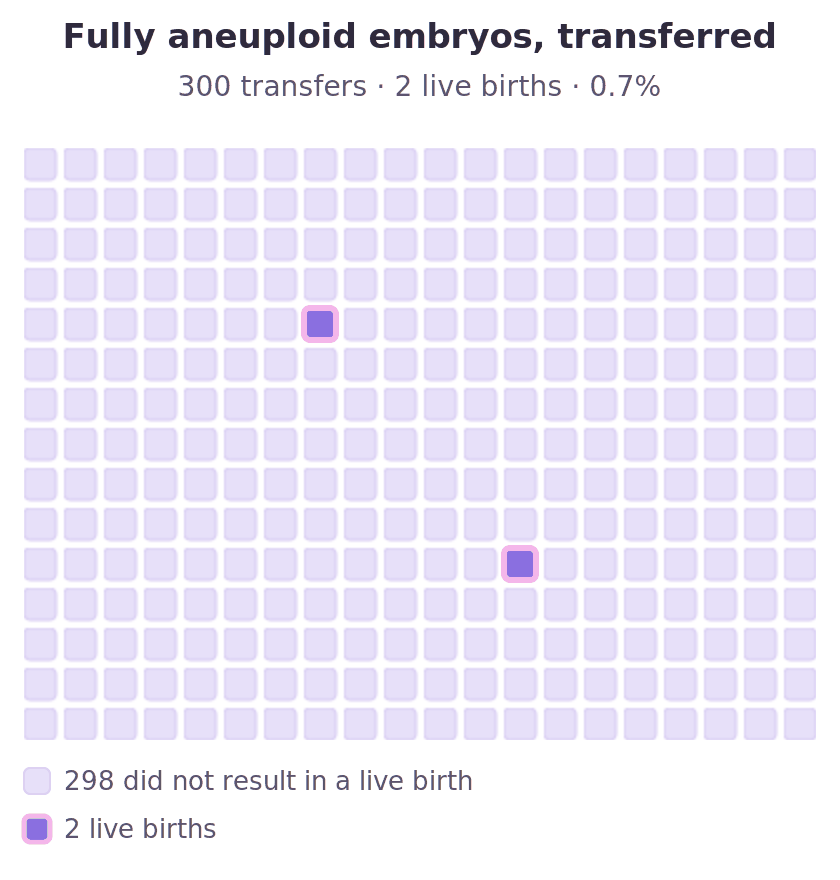
That number is not the error rate of PGT-A, and I don’t want anyone quoting it that way. It’s the observed live-birth proportion in this particular group of transfers.
A separate review in the American Journal of Human Genetics reached the same place from a wider pool of data: uniformly aneuploid embryos failed to produce chromosomally normal live births in over 98% of transfers, and carried a miscarriage risk of 86.3%. The same review found that low-range mosaic embryos performed similarly to euploid ones. Both halves of that sentence matter, and they are exactly the two things the podcast collapsed into one.
So Where Does That 0.7% Come From?
Two live births out of 300 is not zero, and I would rather explain it than wave it away.
It is not embryos fixing themselves. The likeliest explanation is far more boring: the biopsy sampled the wrong handful of cells. An embryo that is genuinely mosaic, with normal and abnormal cells mixed through it, can hand over a sample that reads as uniformly abnormal. Add the ordinary technical limits of analyzing a very small amount of DNA, amplification errors and the occasional sample problem, and you get a rare misclassification.
How rare? In Kim et al.’s study of 300 donated blastocysts, embryos were re-biopsied and retested. An initial euploid or whole-chromosome aneuploid call was reconfirmed in more than 99% of the later samples. Whole-chromosome results are among the most reproducible things on a PGT report.
So the exception is a labelling problem. It is not evidence that aneuploid embryos routinely become healthy babies.
Does the Biopsy Itself Damage the Embryo?
This is the companion claim, and I hear it most from the patients with the fewest embryos and the most to lose if they get this wrong. The version aimed at women over 40 is that their eggs and embryos are too fragile to survive testing.
Tiegs et al. looked at this directly, and the design was clean: embryos that had been biopsied, with the results hidden from everyone, compared against embryos from age-matched patients that were never biopsied at all. Sustained implantation was no different between the two groups.
There is no data showing that removing a few trophectoderm cells from a blastocyst harms an embryo’s reproductive potential. It’s just not a thing. What this myth does do is push people toward transferring untested embryos at precisely the age when chromosomal error is most likely, which buys failed transfers, miscarriages, and delay. Time is the one thing in fertility you can’t get back.
What This Does Not Mean
Here is where I get to disagree with myself a little.
PGT-A is not for everyone, and I don’t use it in every case. The American Society for Reproductive Medicine says its value as a routine screening test for all IVF patients is unclear, and that is a fair position to hold. I’ve also written about why I don’t recommend PGT-P to my patients, so I am not here defending every genetic test with three letters in its name.
It does not mean mosaic embryos should be discarded. Transferring a mosaic embryo is accepted care: genetic counselling first, generally lower implantation odds and a higher miscarriage risk than a euploid transfer, prenatal testing afterwards. That has been my clinical position for years.
It also does not mean a normal result is a guarantee. A euploid embryo can still fail to implant or end in miscarriage, for reasons PGT cannot see.
And watch the denominator. “80% of mosaic embryos that implanted resulted in live birth” is not the same claim as “mosaic embryos have an 80% live birth rate.” The first has already removed every embryo that never implanted from the bottom of the fraction. Those two sentences look nearly identical and they mean completely different things. This is how a statistic gets weaponized without anyone technically lying.
How to Tell a Limitation From a Scandal
There is a real difference between “PGT has limitations” and “PGT is making patients throw away healthy babies,” even though the two often get said in the same breath. The first is true, and most of this post has been about exactly what those limitations are and where they come from. The second does not follow from it.
When you’re weighing up fertility content online, three questions:
- Is the speaker distinguishing aneuploid, mosaic, and segmental results, or using “abnormal” for all three?
- Can you actually look up the studies being cited?
- Is the statistic using the denominator you think it is?
If you have a complicated PGT report, sit down with your REI and a genetic counselor and go through the actual report before you decide anything about an embryo. Not a podcast. The report.
If this was useful and you want more of it, follow me on Instagram, sign up for my free monthly newsletter, The Lucky Egg Drop, or pick up my book, The Lucky Egg: Understanding Your Fertility and How to Get Pregnant Now, where I go much deeper on PGT, mosaicism, and how embryo selection actually works. If you want a sense of your own odds, my Euploid Embryo Predictor estimates the chance of making a euploid embryo based on age and AMH.
FAQ on PGT-A and Abnormal Embryos
Can a PGT abnormal embryo become a healthy baby?
Almost never, when “abnormal” means uniform whole-chromosome aneuploid. Across 300 such transfers in the published literature there were two live births, roughly 0.7%. Mosaic and segmental embryos are a different category and do have meaningful reproductive potential.
Do abnormal embryos correct themselves?
No. This is the piece of the myth I would most like to retire. The rare live birth after a fully aneuploid result is best explained by the biopsy having sampled an unrepresentative few cells from an embryo that was actually mosaic, not by an aneuploid embryo repairing its own chromosomes.
Does the biopsy for PGT damage the embryo?
There is no data supporting that. When blinded, biopsied embryos were compared with never-biopsied embryos from age-matched patients, sustained implantation was no different. The biopsy removes a few cells from the layer that becomes the placenta and does not touch the inner cell mass.
Should I transfer a mosaic embryo?
It is a reasonable option for many people and it is accepted standard of care with counselling. The specifics matter: whether the mosaicism is low or high level, which chromosome is involved, and whether it’s a whole chromosome or only a segment. I walk through how I counsel patients on that decision in my post on whether to transfer a mosaic embryo. Euploid embryos are prioritized first when you have them, a genetic counselor should be part of the conversation before you decide, and prenatal genetic testing matters afterwards if the transfer works.
Is PGT-A recommended for every IVF patient?
No, and I don’t use it in every case. ASRM’s position is that its value as a routine screen for all IVF patients is unclear. In my practice it earns its place most clearly with advancing age, recurrent pregnancy loss, repeated failed transfers, and when patients are banking embryos and need to know what they actually have. It is a screening tool rather than a guarantee, which is why miscarriage can still happen after a PGT-normal transfer. That last part is my clinical opinion, not a guideline.